

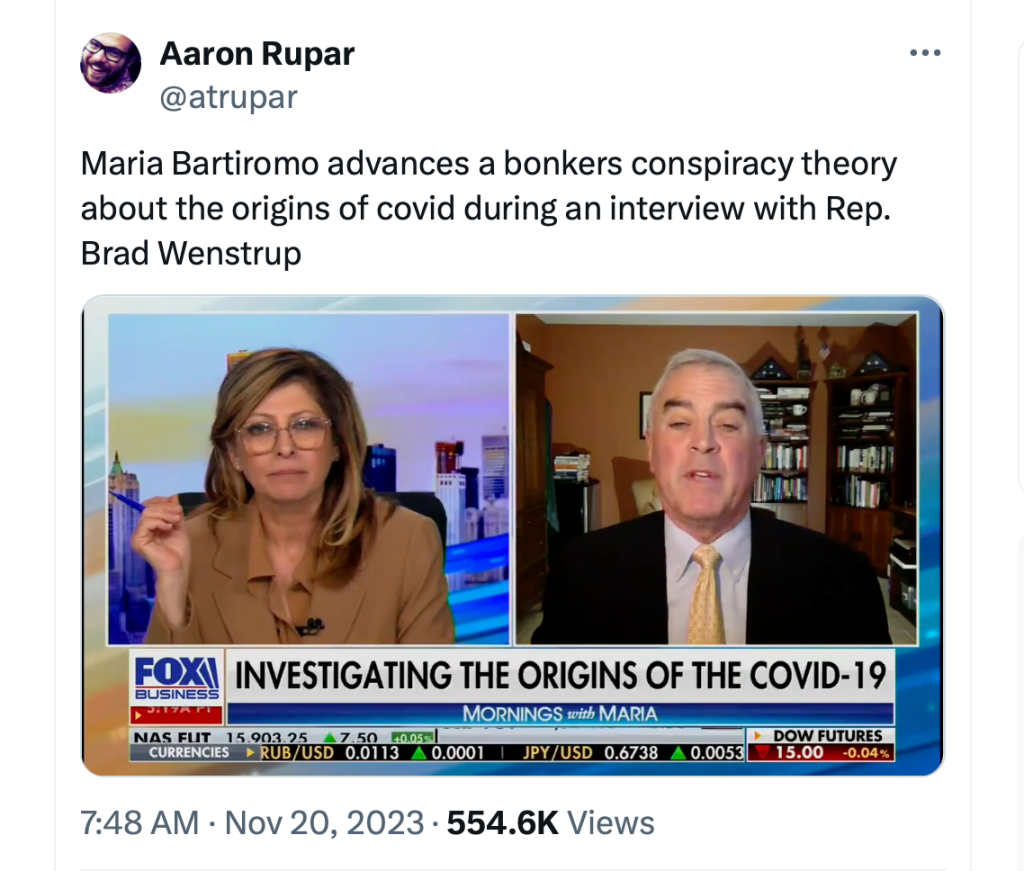
Asked and not answered: Fox Business host Maria Bartiromo, who infamously peddled conspiracy theories about the 2020 election that were concocted by a woman who believes she can talk with the wind, in an interview with Republican member of the US House of Representatives Dr. Brad Wenstrup, asked whether China released the Covid virus intentionally to hurt Donald Trump to disrupt the country and get “their man, Joe Biden” in.
Aaron Rupar of ABC News posted the relevant segment of the interview here.
I made the illustration and posted the reply below:
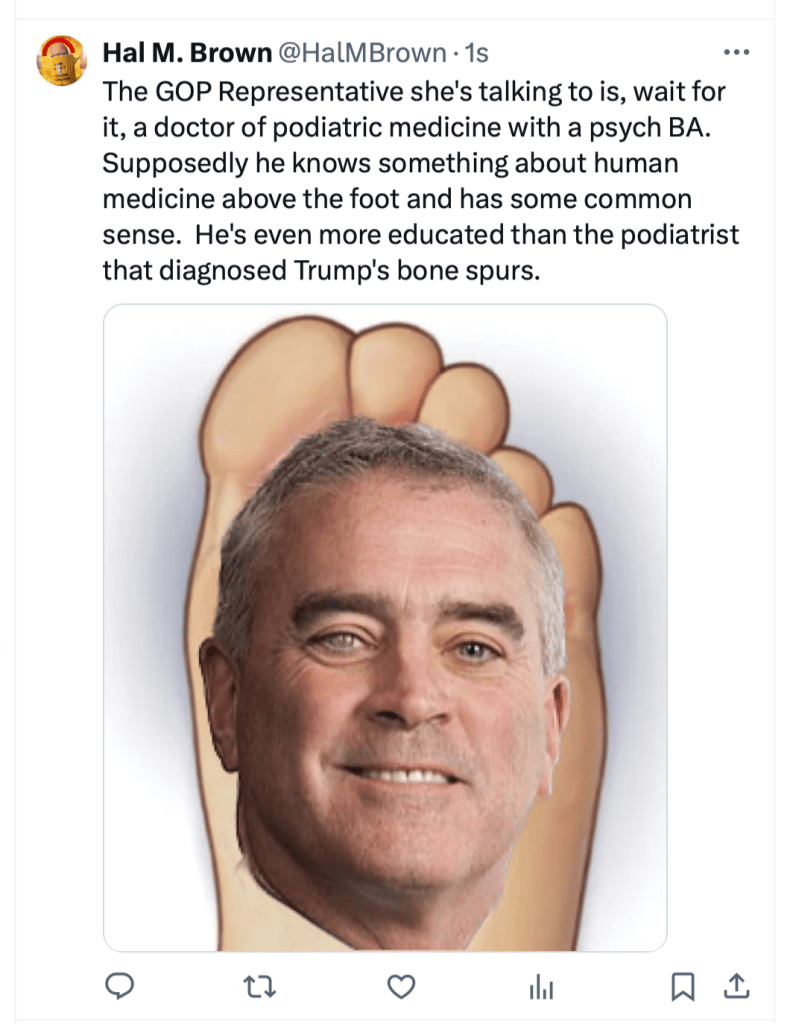
The foot doctor wasn’t about to call cray-cray on a cra-cray question. His non-answer: “whether it was intentional or accidental they seemed to be aware of it.” He goes on to blame President Xi for telling Trump there was nothing to worry about.
What he could have said:
Maria, I am no fan of China, but it is nonsensical to think that China would release a highly contagious and deadly virus in their own country that would kill millions of their own citizens and cost trash their economy on purpose to effect American politics.
Foot doctor or not, this man also has a BA who, like me, was an undergraduate psychology major. This means he took one or more courses in abnormal psychology. He ought to recongize cray-cray when he sees it.
Addendum:
If Bartiromo was unique we could write her off as an unpleasant aberration. After all, she’s not even spewing dangerous nonsense on Fox News. She’s been relegated to Fox Business where the lead story when I looked at this morning was about mayonaise and hamburgers. Unfortunately enough people believe outlandish conspiracy theories to determine who they vote for.
The reasons people believe things (other than those related to religious faith where there’s no scientific test that can determine whether or not God exists) that defy logic where belief can be subject to testing using the scientific method or adhering to principles of rational thinking (in current politics called conspiracy theories like Jewish space laser and Pizzagate, and just the other day that the FBI sent bus loads of agents to foment the J6 attack) has been the subject of scientific research. For example:
- (The APA is the American Psychological Association)
- https://www.apa.org › news › podcasts › speaking-of-psychology › conspiracy-theoriesWhy people believe in conspiracy theories, with Karen Douglas, PhD In our research, we generally find that older people believe in conspiracy theoriesless than younger people do. That tends to show up in most of the studies that we have run. So there’s simply a correlation between conspiracy belief and age. That is a negative correlation, so the older you are, the less you believe in conspiracytheories.
- https://www.livescience.com › why-people-believe-conspiracy-theoriesWhy do people believe in conspiracy theories? | Live Science Simply put: a conspiracy theory needs to appeal directly to people who will be willing to believe it, exactly at a time when they’re most likely to believe it, and there needs to be a group or …
- https://psychcentral.com › blog › conspiracy-theories-why-people-believeWhy Do Some People Believe in Conspiracy Theories? – Psych Central According to a 2018 study, people who believe in conspiracy theories tend to show personality traits and characteristics such as: paranoid or suspicious thinking. eccentricity. low trust in others …
- https://www.verywellmind.com › why-do-we-believe-conspiracy-theories-5181316What Are Conspiracy Theories? – Verywell Mind Conspiracy theories offer a way for people to feel safe and have some sort of autonomy or control within random events. It is a coping mechanism for those who feel at the mercy of fate. People are more susceptible to them when they are anxious and feel powerless.
- https://www.scientificamerican.com › article › why-people-believe-conspiracy-theoriesWhy People Believe in Conspiracy Theories – Scientific American People who believe in one conspiracy theory are likely to espouse others, even when they are contradictory. Conspiracy ideation is also linked with mistrust of science, including well-established …
It’s entertaining to suspend disbelief when watching science fiction TV shows like the three classics, Twilight Zone (this episode was based on a real event), Outer Limits, or The X Files, or reading some sci-fi fantasy novels like those by one of my favorite authors, Clifford Simak. For example in The Big Front Yard a spatial gateway splits a man’s house and it opens onto another world. The man, a Yankee trader, drives in to explore and to dicker with the locals. It was the winner 1959 Hugo for Best Novelette.
The problem for society arises when a significant number of people believe what, like the poster in Mulder’s office in the X-Files says, “I want to believe” and then go ahead and believe whatever it is without Sculley the skeptic to bring in a good dose of reality testing (read article about the poster here).
 Hal Brown's Stressline
Leave a comment